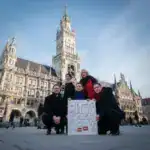
Munich, January 16 – A decade ago, Jakob Bergmeier, a trained electrical engineer, embarked on a mission to connect his grandmother, then residing in a nursing home, with her family’s daily life. What began as a simple cardboard box with three buttons and a small processor has evolved into Enna, a Munich-based startup that is now digitally connecting thousands of seniors with their families across Germany.
Enna: A Solution to Digital Exclusion for the Elderly
Bergmeier’s personal experience of his grandmother feeling disconnected from family life, with conversations often limited to weather updates, spurred him to action. His initial prototype, a rudimentary device connected to a monitor, allowed him to send pictures and messages to his grandmother via a custom-built app. Today, Enna is a company with 23 employees, serving over 7,000 seniors and actively used by 35,000 individuals through its accompanying app.
Astrid Mönnikes, head of the “Digitalpakt Alter” (Digital Pact for Seniors) – a federal family ministry project aimed at promoting digital participation among the elderly – highlights the critical need for such innovations. “Almost everyone today has a suitable device to go online. The problem is that many cannot use it,” Mönnikes states. The nationwide representative study “Senior:innen, Information Medien” (SIM) reveals that approximately five million Germans never use the internet. Among those over 60, 13 percent are completely “offline,” a figure that rises to 38 percent for seniors over 80.
Mönnikes emphasizes that the increasing digitalization of society, where essential services like Deutschlandticket purchases, doctor’s appointments, and even some city consultations are predominantly digital, leaves many behind. This digital exclusion can lead to loneliness and, in the context of medical services, directly impact health. “Feeling digitally excluded can lead to loneliness, and with medical services, health directly depends on it,” she warns.
How Enna Works: Simplicity and Accessibility
Jakob Bergmeier demonstrates the evolution of his invention in Enna’s Munich office. The device is a docking station designed to hold a tablet as a screen, resembling a child’s game console. It features a button for navigating forward, one for backward, and a central area for placing action cards. These cards, similar in size to EC cards, allow seniors to operate Enna with ease. Each card corresponds to a specific action, and only the content related to that card appears on the screen, ensuring a clear and straightforward user experience.
For instance, if Bergmeier’s grandmother wishes to view her grandson Emilio’s photo album, she simply places the card labeled “Photos of Emilio” onto the station. To initiate a video call with Jakob, she places the “Call Jakob” card on the contact area. Enna can also be programmed for various other functions, such as displaying weather forecasts or playing favorite series, offering a versatile yet user-friendly interface.
Impact and Future of Digital Inclusion for Seniors
Since its market launch in late 2022, over 7,000 Enna devices are in circulation. Customers rent the device along with a starter card set and pay a monthly fee. The active engagement of its users is evident on Enna’s website, where testimonials abound. One woman shares how her mother now participates much more actively in family life. A 90-year-old grandfather quickly adapted to the technology, and another senior, according to her daughter, feels as if she has a new flatmate – Enna.
Astrid Mönnikes notes that the economy is only just beginning to recognize older people as a target group and address their needs in the digital age. “Seniors need reliable local structures. They need contact people they can go to for help with internet questions. Data protection is much more important to older people than to young people. And they need applications that are easy to use. If they see that a digital device makes their lives easier, they will use it,” she explains.
Enna’s success underscores a growing understanding that digital inclusion for seniors is not just about technology, but about fostering connection, combating loneliness, and ensuring that all generations can participate fully in a rapidly digitizing world.