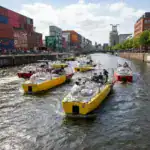
Berlin – A fleet of autonomous electric boats is being developed to transport parcels through Berlin’s waterways, aiming to alleviate congested city streets and optimize last-mile delivery. The A-SWARM II research project, spearheaded by TU Berlin in collaboration with several partners, envisions a future where small, solar-powered vessels navigate canals, delivering goods to distribution centers for onward transport by cargo bikes or electric vehicles.
Autonomous Ships: A Solution for Urban Logistics
The concept involves small, yellow boats equipped with solar panels and carrying parcels for delivery. These vessels operate autonomously, detecting obstacles and independently navigating to various docking stations. For longer distances, they can link up to form a larger convoy, conserving energy, before separating again as they approach their destinations. This innovative system aims to shift a significant portion of parcel traffic from Berlin’s roads to its extensive network of canals and rivers.
Professor Gerd Holbach, project leader and an expert in Maritime Systems Design and Operation, highlights the historical significance of Berlin’s waterways in supplying the city. He emphasizes that while the goal is not to transfer all delivery traffic to water, the waterways offer a crucial opportunity to relieve pressure on roads, particularly for the “last mile” of delivery.
The A-SWARM II Project: Key Features and Timeline
The A-SWARM II project is currently undergoing testing in Berlin’s Westhafen. The initiative is focused on developing electrically powered autonomous water vehicles capable of transporting parcels and linking together into larger units. The project aims to demonstrate the feasibility of autonomous navigation, cargo handling, and parcel logistics by the end of 2027.
The system is designed to transport goods between larger distribution centers located on the city’s outskirts or beyond, and smaller transshipment points within the city. From these points, cargo bikes or electric mini-vehicles will undertake the final delivery to customers.
Seamless Cargo Transfer and Digital Control
A key innovation of the project is the use of standardized interchangeable containers that fit both the boats and cargo bikes. This eliminates the need for re-sorting individual parcels at the shore. At the transshipment points, a handling system lifts the entire container ashore, allowing a courier to take over and distribute the shipments in the surrounding area. This approach is expected to reduce long journeys between parcel centers, micro-hubs, and delivery districts, or shorten them significantly via waterways.
Project calculations suggest that transshipment points with a five-kilometer radius could collectively serve between 1 million and 1.8 million Berlin residents, provided suitable locations are established along the waterways.
The project team is also developing autonomous loading and unloading stations, designed as six-meter containers. These stations are equipped with sensors, a gripping system, and, if necessary, charging technology for the batteries. Their enclosed design protects both personnel and equipment, and they require minimal fixed infrastructure, allowing for relocation if needed due to urban development or resident concerns.
Swarm Intelligence and Energy Efficiency
The small water vehicles are designed to operate individually or to connect into larger units. For longer stretches, a more powerful boat can push several smaller vessels, saving energy. Within the city, the convoy can disband, with individual boats navigating to specific areas like Spandau, the city center, or Köpenick.
The formation of these swarms requires centimeter-precise maneuvering, facilitated by a magnetic system for connection and disconnection. Unlike traditional inland navigation where ropes are used, this process is entirely automated. Sensors continuously monitor other ships, bridges, shores, and floating obstacles. Additionally, boats within the convoy exchange data on route, speed, and energy consumption.
A digital control system will oversee each vessel, tracking its location, charge status, and maintenance needs. This system will also determine which boat takes on a specific task and where multiple units can efficiently link up, aiming for minimal power consumption and punctual arrivals.
Challenges and Future Outlook
The TU Berlin is contributing its expertise in maritime system technology, cargo integration, energy supply, and logistics to the digital control of these autonomous boats. The specific requirements for loading and unloading vary depending on the cargo, with parcels needing different securing, cooling, hygiene, or loading concepts compared to beverages, refrigerated foods, or waste.
The project is also examining various containers, energy requirements, and charging procedures, as it is yet to be determined whether the batteries will suffice for an entire workday or if additional charging points along the canals will be necessary.
Test drives are already underway in Berlin’s Westhafen, where the vehicles are learning to perceive their surroundings, avoid obstacles, and dock with other units. DHL, which already transports parcels in Berlin using electric, solar-powered ships (though not autonomously), is contributing its experience to the development.
Before regular deployment, several legal questions remain. While regulations exist for self-driving cars, comparable rules for autonomous inland vessels in urban environments are lacking. Approvals for berths, transshipment points, and automated operations also need to be clarified.
Professor Holbach views the integration of waterways as a crucial future strategy: “If we want to relieve the streets, reduce emissions, and use logistics areas more efficiently, we have to rethink all existing traffic routes. Water is part of that.”
The A-SWARM II project represents a significant step towards a more sustainable and efficient urban logistics system for Berlin, leveraging its unique geographical features to create innovative solutions for modern challenges.
Source: https://www.ovb-online.de/weltspiegel/ein-schwarm-autonomer-schiffe-so-sollen-berliner-kuenftig-ihre-pakete-bekommen-zr-94428542.html