The decision by Munich’s city council to transform the historic Ludwigstrasse into a ‘green boulevard’ from January 1, 2026, is more than just a local regulation aimed at improving the urban climate. It signals a much broader transformation that will redefine the face of European metropolises in the coming decade – and simultaneously tests whether cities are prepared for radical solutions in the fight against climate change, even at the cost of public discontent and historical integrity.
Radical Solution or Necessary Evil?
According to the resolution adopted on May 13, 2026, the Ludwigstrasse – an area historically conceived without trees by architects Leo von Klenze and Friedrich von Gärtner at the behest of King Ludwig I – will be ‘greened.’ This initiative aims to calm traffic and protect against excessive sun, transforming the former architectural showpiece into a ‘promenade’ inviting passersby to ‘linger.’
For many, this is a direct response to the urgent need for climate-resilient cities, acknowledging the benefits of urban greenery in mitigating heat islands and improving air quality. However, for others, it represents a profound disregard for the historical and architectural significance of one of Europe’s most important 19th-century urban ensembles.
But is this solution truly justified? And will it genuinely solve the problem of urban heat, or merely create collateral damage to the city’s historical identity?
The Social Dimension of Ecology vs. Heritage
Adrian von Buttlar, an art and architectural historian, highlights a crucial problem: the plan, while well-intentioned for climate protection, risks causing irreparable harm to the city’s over two-hundred-year-old historical identity. He argues that while planting as many green trees as possible in the inner city is beneficial for the urban climate, it should not come at the cost of destroying the historical characteristics of a ‘world-class ensemble’ like Ludwigstrasse.
The competition, which decided on the landscape architectural redesign of Munich’s historic city center, exemplifies the dilemma of climate protection versus cultural preservation. The Ludwigstrasse, originally designed as a treeless grand avenue, is now slated to become a ‘green boulevard.’
The winning proposal, from the Parisian firm Michel Desvigne Paysagiste, proposes a clever distribution of ‘tree islands’ while maintaining some sightlines to facade sections. This design also considers the need to keep areas clear for open-air concerts like ‘Klassik am Odeonsplatz’ and temporary stands for the Oktoberfest parade and traditional costume parades. This approach, while seemingly pragmatic, is euphemistically described by its proponents as ‘continuing’ the historically protected ensemble into the 21st century, even hailing it as a model for dealing with historic old towns.
However, von Buttlar strongly disagrees, stating that ‘the opposite is true and reveals the galloping historical amnesia and architectural-historical ignorance of those responsible.’ He argues that the competition’s premises aim at the destruction of the monument characteristics of this urban artistic masterpiece, which includes not only the buildings and their varied facades but also the spaces, squares, and majestic sightlines they constitute.
Is the City Ready for Change?
A key question arises: can a parade street, designed as an elongated, architecturally strict hall square, be transformed into a casual ‘boulevard’ without a total loss of its character? Experts, particularly those specializing in monument preservation, likely harbored doubts from the outset. It appears that the competition brief represents an attempt on an unsuitable object, possibly inadequate in terms of technical feasibility and climatic effectiveness.
Why Ludwigstrasse, and not the surrounding dreary side streets and vacant lots? There is a lingering suspicion that climate anxiety serves as a convenient pretext for a semantic re-evaluation and devaluation of the still-powerful monumental ensemble, perceiving itself as a democratic appropriation of an ideologically suspect heritage.
Ludwigstrasse, with its Renaissance facades echoing Florence and Rome, was indeed ‘governance architecture’ intended to compete with Napoleonic state architecture in Paris. Critics suggest that the current plans aim to break the ‘axis of power’ through ‘tree islands’ and adapt it to contemporary lifestyles, perhaps as a reaction to its perceived feudalistic and elitist connotations.
The winning design, for instance, transforms the Odeonsplatz, with the equestrian monument of the king, into a giant sandbox. This, von Buttlar suggests, is an act of ‘infantilization,’ disrespectfully marginalizing the architectural messages ‘from another time.’
Historical Context and Alternative Approaches
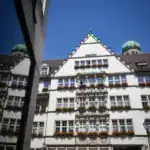
Historically, Ludwigstrasse was a progressive public-private partnership between the monarchy, nobility, and the burgeoning bourgeoisie. It was not built under the old feudal immediate construction system, where all facades had to conform to the royal will. Instead, investors could erect individual houses, some serving as modern apartment blocks behind palace facades. The buildings are closely packed, no two houses are alike, and a color chart with variations in paint ensured a lively, organic, and cohesive appearance.
This also applies to the northern section, with its modern state buildings by Friedrich von Gärtner (Institute for the Blind and Saltworks, State Library, Ludwigskirche, and University), which, like Klenze’s palazzi, are among the best works of Romantic Classicism and were admired by tourists from all over Europe even then.
Von Buttlar argues that there are plenty of inner-city spaces in Munich to set future-oriented accents of green climate policy without signaling that the Ludwigstrasse, lovingly repaired after the war, can be deconstructed simply because it seems ‘out of time’ to some contemporaries – which, he points out, is precisely what constitutes its monumental value. In the process of green urban transformation, it should remain as authentically experienceable as possible ‘island of tradition,’ inviting us to reflect on the highs and lows of our own historical boundedness.
Politics or Populism?
The decision to green Ludwigstrasse has sparked political debate. While proponents emphasize the urgent need for climate action, critics accuse the city administration of prioritizing a superficial ‘green’ image over genuine historical preservation and thoughtful urban planning.
The city’s defense often centers on the long, complex, and costly procedures involved in urban development. However, critics like von Buttlar suggest that this is not a matter of procedures, but of political priorities. Other cities, he notes, have managed to implement green initiatives without compromising their historical core, or by finding more suitable locations for such transformations.
The question remains: Does Munich truly want to improve its urban climate through this project? Or is it merely responding to pressure from climate activists and a desire to appear ‘green’ on the international stage? Is it a genuine effort to adapt to future challenges, or a political gesture before upcoming elections?
What Next?
The transformation of Ludwigstrasse is more than just a local regulation. It symbolizes the tension between two visions for the future of cities: ecological transformation and historical preservation. On one hand, the undeniable data: polluted air and rising temperatures demand action. On the other hand, a society that is not ready – financially, mentally, or culturally – for radical changes that erase its past.
Is a compromise possible? Yes – but it requires political courage, strategic planning, and resources. It demands subsidies, investments in public transport, and dialogue with residents. It requires long-term thinking, not just ad hoc reactions.
The answer will only become clear in the years to come, as the ‘green boulevard’ takes shape. Then we will see if the urban climate truly improves. We will see how much of Munich’s historical identity remains. And above all – we will see if Munich was truly ready for such a change.