Hamburg, August 19 – A 24-hour warning strike orchestrated by the ver.di trade union brought cargo handling at Germany’s major seaports to a near standstill on Tuesday. The industrial action affected key ports such as Hamburg, Bremerhaven, Bremen, Wilhelmshaven, Emden, and Brake. While the strike concluded late Tuesday evening, its impact was significant, with more than 2,000 port workers demonstrating in Hamburg for improved wages and working conditions.
Port Operations Halted Across Northern Germany
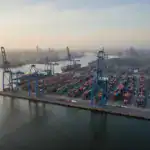
At the terminals of Hamburg Hafen und Logistik AG (HHLA) in Waltershof and Tollerort, as well as at Eurogate, the massive container cranes, typically bustling with activity, stood idle with their arms raised. A similar scene unfolded across other German North Sea ports, extending to Emden. Sylvi Krisch, co-negotiator for ver.di, announced the strike’s conclusion late Tuesday evening.
Clearing the Backlog Expected to Take Time
The Hamburg port operator HHLA had proactively informed its clients and partner companies about the impending warning strike on Monday. While the company did not provide specific details on how long it would take to clear the resulting backlog in cargo handling, a spokesperson stated that efforts would be made to achieve this promptly.
Mass Demonstrations in Hamburg
On Tuesday morning, over 2,000 port employees gathered in Hamburg for a demonstration organized by ver.di. Clad in high-visibility vests and carrying banners, they marched through the port area, chanting slogans such as “The port remains ready for strike.” A rally was also held at the Burchardkai container terminal.
Ver.di Demands Substantial Wage Increases
The warning strike is a direct consequence of ongoing collective bargaining negotiations between ver.di and the Central Association of German Seaport Operators (ZDS). The union is advocating for an 8.2 percent wage increase for approximately 11,000 seaport employees over a 12-month period. The ZDS had previously submitted an enhanced offer, which included a 5.1 percent wage increase over 19 months, an additional 300 euros in holiday pay, and 460 euros for employees of large container companies.
Negotiations to Resume Next Week
In Bremerhaven, port workers also participated in the strike. Ver.di had rejected the employers’ latest offer, deeming it insufficient. Florian Keisinger, Chief Executive of the ZDS, criticized the warning strike as disproportionate, citing existing strains on global supply chains. New negotiation dates have been scheduled for next Monday and Tuesday in Hamburg.
Impact on Container Throughput
The strike comes at a challenging time for the Hamburg port, which has already experienced a decline in container throughput. In the first half of the year, four million boxes were handled, marking a decrease of approximately four percent compared to the same period last year.
Broader Context of Port Strikes
This warning strike is part of a larger pattern of labor disputes in German seaports. Previous negotiations for seaports had failed to reach an agreement, leading to threats of strikes. The current industrial action underscores the ongoing tensions between port workers and operators over wage and working condition demands.
Source: NDR.de