

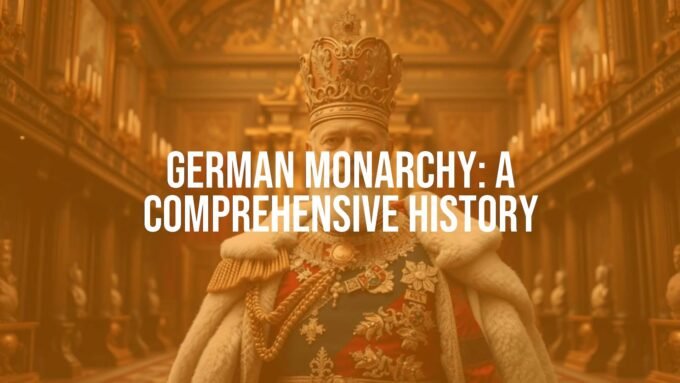
The German monarchy was a form of government where the head of state was a hereditary monarch, ruling over the German Empire from 1871 to 1918. This period was relatively short, less than 50 years, but monarchy in the German regions has a much older legacy. Through different kingdoms, dynasties, and empires, monarchy had a significant impact on German history. Today, Germany is a federal republic, as the monarchy ended in 1918 after World War I.
Understanding the German Monarchy
When people talk about the “German Monarchy,” they often mean the monarchy of the German Empire from 1871 to 1918. But before this united empire, what we now call Germany was made up of many kingdoms, duchies, principalities, and free cities, each ruled by their own nobles or kings. These smaller states were often part of larger empires like the Holy Roman Empire, yet they kept many of their own traditions and rulers.
During the German Empire, the monarchy mixed newer, democratic ideas with old traditions. It was a constitutional monarchy, which means there was an elected parliament (the Reichstag) as well as an Emperor (the Kaiser) and his appointed Chancellor. The Kaiser named the Chancellor without needing a parliamentary majority, but the Reichstag still had to approve laws and the budget.
Monarchy’s Influence on German History
Monarchy helped define Germany even before it was a single nation. For hundreds of years, German-speaking areas were divided into many separate states, often grouped under the Holy Roman Empire (962-1806), which was more an alliance of states than a unified country. Monarchs and royal families guided the governance and identity of these regions over the centuries.
The presence of many royal families led to the construction of many castles-which still exist as reminders of the past. Monarchs and local rulers shaped the extremely varied political map of historic Germany, different from the more unified monarchies elsewhere in Europe.

Titles in German Royalty
Over the years, German rulers used many titles. In the Holy Roman Empire, the main title was “King of the Romans” (rex Romanorum), which was sometimes used for the King of Germany before he became emperor. After 1508, emperors-elect also called themselves “king in Germany,” connecting more directly to the German lands.
In the German Empire (1871-1918), the highest title was “German Emperor” (Deutscher Kaiser). This was chosen to show that the Emperor’s power depended on agreement among the many other monarchs, like the kings of Bavaria, Saxony, and Württemberg, and the grand dukes of Baden, Hesse, and others. The title “Kaiser” comes from “Caesar,” meaning emperor.
Early German Kingdoms and Dynasties (843-962)
After the Frankish Empire was divided by the Treaty of Verdun in 843, East Francia began to develop into what would later become the Kingdom of Germany. Early rulers used titles such as “king of the East Franks” and later simply “king.” The word “German” started to appear in royal titles around the 11th century, sometimes as a form of criticism by the Pope.
Carolingian Dynasty
The Carolingians were the first dynastic kings in what became Germany. After 843, Louis the German, a grandson of Charlemagne, ruled the new East Francia until 876. His sons-Carloman, Louis the Younger, and Charles the Fat-would all hold power after him. Carolingian rule ended in 911 with Louis IV the Child.
Conradine Dynasty
With no direct Carolingian heir in East Francia, the leading nobles chose Conrad I as king in 911. His rule showed the growing strength of the nobility and the increasing use of election over birth in royal succession. Conrad I’s reign lasted until 918 and highlighted the challenges of controlling powerful regional dukes.
Ottonian Dynasty: Setting The Stage for Empire
The Ottonians, starting with Henry I in 919, increased unity in the kingdom and set the stage for the Holy Roman Empire. His son, Otto I, was crowned Holy Roman Emperor in 962, reconnecting German rulers with the idea of the old Roman Empire. The Ottonians would control both Germany and the new Empire for several generations, tying Germany to wider European politics.
The Holy Roman Empire (962-1806)
The Holy Roman Empire, starting with Otto I’s coronation in 962, covered centuries and included many different states ruled nominally by an emperor. Emperors were elected by powerful nobles called electors. Over time, “King of the Romans” meant King of Germany, a title used up to the Empire’s end.
Ottonian Legacy Continues
The early emperors, like Otto II and Otto III, worked to centralize power and connect church and state. Their reigns proved the strength and ambitions of German emperors, even as they sometimes struggled to rule parts of Italy. Henry II ended the Ottonian line, focusing on church reform and tightening royal authority.
Salian Dynasty
After the Ottonians came the Salians, starting with Conrad II in 1024. The Salians focused on stronger imperial control but were also caught in religious conflicts with the Pope, especially during the Investiture Controversy under Henry IV. The Salians’ fixed focus on church influence and holding the empire together left a major mark on the monarchy’s future shape.
Supplinburger and Hohenstaufen Dynasties
Lothair III (Supplinburger) ruled only briefly, but the powerful Hohenstaufens followed. Frederick I Barbarossa, one of the most famous emperors, pursued both German and Italian interests. Frederick II spent much time in Sicily and southern Italy, and his long conflicts with the papacy weakened imperial control over Germany. After Frederick II’s death, there was no firm ruler for decades.

Interregnum (1250-1273) and Dynastic Shifts
After 1250, many tried to claim the throne, but the emperor’s power faded. During this “Interregnum,” regional princes became more independent. The process of electing kings, not just inheriting the throne, became the usual way of picking rulers. Nobles expected rewards for their votes, which decreased royal estates and revenues.
The Habsburgs Take Hold
Rudolf I was elected king in 1273, beginning the long Habsburg dominance. By building up their lands in Austria, the Habsburgs eventually held the imperial office almost without interruption from the 15th century. This gave the empire more stability, even as local rulers kept their independence. After 1508, emperors stopped being crowned by the Pope, underlining their independence from Rome.
The Imperial Election System
- German kings/emperors were usually chosen by election, not just inheritance.
- The Golden Bull of 1356 made the rules for these elections formal.
- To get elected, would-be emperors promised lands and rights to electors, so each new emperor typically had less money and fewer lands.
Modern German Monarchy (1806-1918)
The end of the Holy Roman Empire in 1806-prompted by Napoleon-was a turning point. Old structures were swept away, and monarchy in Germany changed with the times, leading eventually to the creation of the German Empire in 1871.
Confederation of the Rhine (1806-1813)
Formed by Napoleon, the Confederation of the Rhine united several German states under French oversight. Napoleon was its “Protector,” and the political balance shifted dramatically. Many small states disappeared or were merged into larger ones, and the feudal order was weakened.
German Confederation (1815-1866)
After Napoleon, the Congress of Vienna set up the German Confederation-a loose alliance of 39 states with their own monarchs. Austria was the leading power. There was no single German ruler, but several families remained important, including:
- Hohenzollerns of Prussia
- Wittelsbachs of Bavaria
- Wettins of Saxony
North German Confederation (1867-1871)
After the Austro-Prussian War, Prussia led the North German Confederation-a step closer to unification. Prussia’s king was in charge, and all northern states shared an army and foreign policy, moving Germany towards a more modern state with central leadership.
German Empire (1871-1918), The Second Reich
Germany was finally united as an empire in 1871, after war with France. The King of Prussia, Wilhelm I, became the first German Emperor. The empire combined an emperor, an elected parliament, and a federal council. Most German-speaking lands (except Austria, Switzerland, and Liechtenstein) joined together under Prussian and Hohenzollern leadership. This period saw Germany become an industrial and military giant, leading right up to World War I.

The Hohenzollern Family and German Emperors
The Hohenzollerns were the main royal family of Germany during the Empire. Starting as rulers in Prussia, they managed to become emperors of unified Germany. Their rule covered a time of huge change, rapid industrial growth, and, ultimately, war and revolution.
Notable Hohenzollern Monarchs
- Frederick the Great: Prussian king known for military victories and reforms, crucial for future expansion.
- Wilhelm I: First German Emperor, united Germany, worked with Bismarck.
- Frederick III: Son of Wilhelm I, reigned only 99 days in 1888 due to illness.
- Wilhelm II: Last German Emperor, dismissed Bismarck, led Germany through World War I, abdicated in 1918.
List of German Emperors (1871-1918)
| Name | Reign | Notes |
|---|---|---|
| Wilhelm I | 1871-1888 | Proclaimed Emperor at Versailles, led unification |
| Frederick III | 1888 | Ruled 99 days, son of Wilhelm I |
| Wilhelm II | 1888-1918 | Last Emperor, abdicated after WWI |
Modern Day Hohenzollerns
The Hohenzollerns still exist, but they have no special rights or political status. The family is led by Georg Friedrich Ferdinand, Prince of Prussia, a descendant of Wilhelm II. He and his relatives live in Germany and elsewhere, but there is no widespread support to bring back the monarchy. Their old castle, Hohenzollern Castle, is open to visitors and is a well-known landmark.
Royal Consorts and Noble Houses
Alongside each monarch were the royal consorts-usually queens or empresses, often from other royal families-who sometimes played strong roles in diplomacy or social projects. Some acted as regents or were involved in charity. Noble houses, like the Wettins of Saxony or Wittelsbachs of Bavaria, were important in German history. They were powerful regional rulers whose cooperation or rivalry shaped the fate of the country.
Main Noble Families
- Hohenzollerns (Brandenburg/Prussia, then German Emperors)
- Wittelsbachs (Bavaria)
- Wettins (Saxony)
- Welfs, Luitpoldings, Nassaus (other principalities and duchies)
The End of the German Monarchy
The German monarchy ended quickly in 1918. Problems had built up over centuries: royal lands and income slowly shrank, emperors had to give more to get elected, and local princes became more independent. The federal structure meant the emperor was never all-powerful. After World War I, Germany faced starvation, defeat, and unrest. The Kaiser’s government tried to introduce reforms, but public anger and revolution swept away the monarchy almost overnight. On November 9, 1918, Wilhelm II was forced to leave, and Germany became a republic.

Monarchy’s Legacy in Modern Germany
Though Germany no longer has a monarchy, its past is still present. Castles, palaces, and the stories of royal families attract tourists and remain part of German culture. For most Germans, the monarchy is a chapter in history, not a current political option, but the interest in royal history remains strong.
Does Germany Still Have a Monarchy?
No. Since 1919, Germany has been a republic. Former royal families still exist, like the Hohenzollerns, but they have no official status, and their titles are not recognized. Small groups want to restore the monarchy, but there is very little support for this in modern Germany.
Common Questions About the German Monarchy
- Why did the German monarchy end?
Massive problems during and after World War I, including military defeat and revolution, forced Kaiser Wilhelm II to step down. The old problems (weak finances, loss of power to princes and parliament) made it hard to survive after the war. - Was the Holy Roman Empire the “First Reich”?
Yes, many historians and some 20th-century writers called the Holy Roman Empire the “First Reich.” The German Empire (1871-1918) was the “Second Reich.” These names are less used today, but they refer to the main phases of German monarchy. - Who were the most famous German monarchs?
- Charlemagne-founder of the Holy Roman Empire (8th-9th centuries)
- Otto I-the first Holy Roman Emperor crowned by the pope (962)
- Henry IV-notable for his conflict with the pope during the Investiture Controversy
- Frederick Barbarossa-medieval emperor famous for campaigns in Italy and the Crusades
- Charles V-ruled both Spain and the Holy Roman Empire during the Reformation
- Wilhelm I-first emperor of unified Germany
- Frederick the Great-Prussian king, influential for military and cultural reforms
- Wilhelm II-last emperor, ruled during WWI
Further Reading and More Resources
If you’re interested in learning more, there are many lists and books on German kings and emperors, royal dynasties, and castles. These resources offer a chance to see how the monarchy changed, which families ruled, and how ordinary people’s lives were affected by royal decisions. Museums, documentaries, and castle tours provide a direct way to connect with this part of German history.
Sample Table of Major German Monarchs (Summary)
| Dynasty | Example Monarchs | Period |
|---|---|---|
| Carolingian | Louis the German | 843-911 |
| Ottonian | Otto I | 919-1024 |
| Salian | Henry IV | 1024-1125 |
| Hohenstaufen | Frederick I Barbarossa | 1138-1254 |
| Habsburg | Frederick III, Charles V | 1273-1806 |
| Hohenzollern | Wilhelm I, Wilhelm II | 1871-1918 |
Whether you are interested in major rulers, family stories, or the many castles left behind, German monarchy provides a window into the country’s history, politics, and culture.









Leave a comment