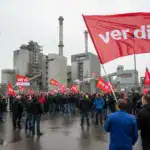
A 200,000 Euro study, intended to evaluate Berlin’s Assembly Freedom Act (VersFG), has instead ignited a political firestorm within the city’s government. The study, published today by the HWR (University of Applied Sciences for Economics and Law), concludes that Berlin’s already liberal demonstration laws should be further relaxed – a recommendation vehemently rejected by the Senate’s Interior Administration, led by Senator Iris Spranger (SPD).
A Costly Study, a Controversial Outcome
The evaluation, mandated by the 2021 red-green-red Senate, has been ongoing since March 2024. Its findings, however, have deeply displeased the Interior Administration. “The study exhibits severe methodological flaws,” criticizes State Secretary for the Interior, Christian Hochgrebe (SPD). “It grossly generalizes the police’s work based on a few interviews.”
This isn’t the first time the HWR’s work has faced skepticism. An initial interim report in April 2025 was dismissed by Spranger’s office due to similar methodological concerns. Hochgrebe argues that with 7,500 assemblies held annually in Berlin, most of the study’s proposals are simply impractical. The Interior Administration denies accusations of questioning scientific findings, asserting that a truly scientifically sound study would not be doubted, but they deem the HWR report to be more sociological than legal in nature.
Key Recommendations and Interior Administration’s Rebuttal
The HWR team advocates for a “peer-to-peer” cooperation dialogue between demonstration organizers and the police. In practice, this would mean police guidelines on risks, routes, and conditions would only be advisory. The Interior Administration argues this would contradict the police’s neutral role in assembly law, emphasizing the importance of protecting demonstrators themselves.
Furthermore, the study suggests abolishing the role of assembly leaders for demonstrators. The rationale is that leaders can be fined for violations, making it unaffordable for low-income individuals to organize protests, thus leading to social discrimination. This proposal has been met with incredulity. “The authors of the report apparently assume that assembly leaders cannot be expected to adhere to the applicable rules,” Hochgrebe retorts.
Police Classification and the ‘Public Order’ Debate
The study also criticizes the Berlin police’s alleged “friend-foe mentality,” particularly in handling pro-Palestinian demonstrations. It argues that the police’s classification of protests as “pro-Palestinian,” “left-wing extremist,” or “right-wing extremist” leads to biased pre-assessments. The Interior Administration counters that such classifications are essential for assessing potential threats.
Perhaps the most contentious point concerns the reintroduction of the term “public order” into the Assembly Act. The current governing coalition aims to reintroduce this concept to make it easier to prohibit assemblies. “Public order” broadly encompasses unwritten societal rules and moral values, the breach of which would have “intolerable” consequences for society, the rule of law, and democracy. It serves as an “ultima ratio” for banning demonstrations. The HWR study’s authors strongly oppose its reintroduction, fearing it would allow the “dominant society” to consistently suppress minorities.
This view is not universally shared. Stephan Weh, state chairman of the Berlin Police Union (GdP), asserts, “CDU and SPD know that they need to adjust the Assembly Freedom Act. Extremists of all stripes have repeatedly shown us in recent years that the law has gaping loopholes through which the fundamental right to freedom of assembly is abused for hatred, incitement, and violence.”
The Future of Berlin’s Protest Landscape
Weh emphasizes that while the evaluation provides a theoretical perspective, it should not be the sole measure. “We expect that practitioners, in particular, will have their say in the political participation process,” he states. He warns that unchecked freedom could lead to a situation where it can no longer be protected, citing “demonstration tourism” to the capital as evidence of the current system being pushed beyond its limits.
Despite the HWR study’s recommendations, the black-red Senate is not obligated to implement them and has no intention of doing so. The reintroduction of the “public order” concept is firmly enshrined in the coalition agreement. “The plan is to pass a new Assembly Freedom Act before the summer break,” announces State Secretary Hochgrebe. This new law will, in all likelihood, be stricter, not more liberal, much to the dismay of the opposition.
Vasili Franco, interior policy spokesman for the Berlin Greens, criticizes the Interior Administration’s stance as “petty and unconvincing.” He argues, “The study clearly shows that no legal tightening or restrictions are necessary.” Franco believes that anyone seeking to restrict or ban demonstrations based on public order reveals an authoritarian understanding of the state.
The debate highlights a fundamental tension between ensuring public safety and upholding fundamental freedoms. As Berlin continues to be a focal point for diverse demonstrations, the outcome of this legislative battle will significantly shape the city’s democratic landscape for years to come.
Source: https://www.morgenpost.de/berlin/article411446161/demonstrationen-in-berlin-sollen-mehr-freiheiten-bekommen-innenverwaltung-wuetend.html