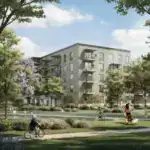
The decision to greenlight the Neulichterfelde project, a sprawling 36-hectare development in the south of Berlin, is more than just a localized response to housing shortages. It represents a pivotal moment for the German capital, a test of its capacity to deliver affordable housing on a grand scale while navigating complex economic and social dynamics. This mega-project, spearheaded by a joint venture between the state-owned degewo and developer WÖHR + BAUER, comes at a time of both cautious optimism and persistent challenges for Berlin’s housing sector.
A City Quarter Rises: More Than Just Bricks and Mortar
After years of meticulous planning, the former military training ground in Steglitz-Zehlendorf is finally set to transform into a vibrant city quarter. The Groth Group, which championed the project for over a decade, has handed over the reins to the new joint venture. The vision for Neulichterfelde is comprehensive, aiming for a diverse mix of residential units, including approximately 540 subsidized rental apartments by degewo, around 1,540 privately financed units, and 420 terraced houses. Beyond housing, the development will integrate three daycare centers, a school with sports facilities, and a sprawling 61-hectare natural pasture landscape, emphasizing green spaces and community infrastructure. Industry observers are already hailing this collaboration between public and private entities as a potential blueprint for future urban development.
The Numbers Game: A Surge in Building Permits and Shifting Rents
The launch of Neulichterfelde aligns with a period of robust figures from Berlin’s housing market. The Office for Statistics Berlin-Brandenburg recently reported a substantial increase in building permits, with 14,079 apartments approved in 2025 – a remarkable 44.1 percent jump compared to the previous year. This contrasts sharply with Brandenburg, where permits declined by over 12 percent during the same period. The Investitionsbank Berlin (IBB) forecasts approximately 16,300 completed apartments for 2026, fueled by a significant backlog of around 50,000 approved but unbuilt units. Concurrently, the city is heavily investing in infrastructure, with the state-owned Howoge set to deliver five new schools offering over 4,000 places by summer.
Despite this construction boom, housing in Berlin remains notoriously expensive. However, the latest IBB housing market report reveals the first glimmers of stabilization. The average asking rent saw only a minimal increase last year, reaching 15.78 Euros per square meter. A minor sensation, however, is the development in new builds: here, average asking rents decreased from 20.50 to 19.97 Euros per square meter. Hinrich Holm, IBB board member, attributes this to a “limit of affordability” being reached, making it harder to rent out high-priced apartments and thus leading to price adjustments.
The Affordability Gap: Who Benefits from the New Supply?
Despite the slight dip in new build rents, a significant affordability gap persists. According to the IBB, an average Berlin household can afford cold rents of 12.00 to 12.90 Euros. With new build apartments still averaging almost 20 Euros, the increased availability primarily benefits high-income households. This raises critical questions about social equity and whether the current development trajectory truly addresses the needs of all Berliners.
Political Will and Practical Challenges: Can the Momentum Be Maintained?
How can affordable housing be created more quickly? This question was at the forefront of Building Senator Christian Gaebler’s discussions at the MIPIM real estate fair in Cannes this week. His strategy centers on accelerating planning processes. Tools like the “Bau-Turbo” are designed to facilitate larger projects without lengthy zoning procedures. Furthermore, a new Berlin high-rise guideline, introduced at the beginning of the year, aims to provide investors with planning certainty. While the industry welcomes these initiatives, it warns of growing problems nationwide. The primary cost drivers today are less about financing and more about complex regulations, protracted procedures, and high material costs.
The critical question remains: can this momentum be sustained? While clearing the existing construction backlog will stabilize completion figures in the short term, the long-term success hinges on whether costs can be reduced sufficiently to enable construction for middle-income households. This requires a concerted effort to streamline regulations, control material costs, and potentially explore innovative construction methods. Without addressing these fundamental challenges, Berlin risks exacerbating social inequalities despite its ambitious construction targets.
A Model for the Future or a Missed Opportunity?
The Neulichterfelde project, with its blend of subsidized and market-rate housing, green spaces, and community facilities, holds immense promise. It represents a significant step towards alleviating Berlin’s housing crisis. However, its success will not only be measured by the number of units built but also by its ability to create a truly inclusive and affordable urban environment. The slight decrease in new build rents is a positive signal, but it must be viewed within the broader context of persistent affordability challenges for a large segment of Berlin’s population. The coming years will reveal whether Neulichterfelde becomes a shining example of sustainable urban development or another missed opportunity to deliver truly affordable homes for all.
Source: https://www.ad-hoc-news.de/boerse/news/ueberblick/berlin-startet-mega-projekt-neulichterfelde-mit-2-500-wohnungen/68664994