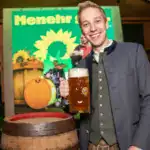
Munich, Bavaria, Germany – Dominik Krause (Greens) officially assumes the role of Mayor of Munich on May 1st, 2026, following twelve years under Dieter Reiter (SPD). In an exclusive interview with BR24, the 35-year-old detailed his vision for the city, focusing on financial recovery, housing, mobility, public transport expansion, and administrative modernization. His official inauguration is scheduled for May 11th.
Ambitious Housing Goals and Administrative Reforms
Krause has set an ambitious target of creating 50,000 new homes in Munich. Acknowledging the challenge, he stated, “I was repeatedly warned against naming a specific number, that it would be dangerous and as a politician, you’ll be nailed down to something like that, but if you don’t start with these goals, you can never get in that direction.” His plan involves a multi-faceted approach, including densification and adding stories to existing buildings, such as single-story supermarkets, as well as new developments in the north and northeast of Munich and converting vacant office spaces into residential units.
Another key objective for the new Mayor is a comprehensive administrative reform. Krause emphasized the urgent need for the administration to become more digital, interconnected, and efficient. He highlighted the importance of better networking between departments and fostering a different “culture of error.” As a first official act, he has already reinstated in-person meetings for the “Referentenrunde,” the city’s cabinet, aiming to infuse them with more substantive discussions, a practice he noted was prevalent during the tenure of former Mayor Christian Ude (SPD).
Collaboration with the State and Federal Governments
Krause expressed his intention to visit Berlin soon for discussions with various ministries, emphasizing the importance of personal exchange over written correspondence to “open one door or another.” He cited the financing of public transport as an example of municipal dependence on federal support, stating, “I believe it is also in the interest of the federal government if economically strong cities like Munich function well and thrive. But that means we also need the basis for it.”
Regarding his relationship with Bavarian Minister-President Markus Söder, Krause anticipated a relaxed collaboration. After some deliberation, he acknowledged Söder’s strong advocacy for Bavarian interests across Germany. “Whether he always does it with the right tone is another question, but I think it’s important that Bavaria is also strongly represented,” Krause remarked. Their initial post-election meeting was cordial, with both acknowledging the mutual reliance of the Free State and the city for successful cooperation.
Oktoberfest, Olympics, and Football
No Munich Mayor can escape questions about Oktoberfest. When asked about which breweries would be allowed to serve beer at the Wiesn, Krause affirmed, “Oktoberfest is a festival of Munich beer, and in my opinion, that’s exactly how it should stay.” He specifically mentioned the local Giesinger brewery, which sought to gain admission to Oktoberfest via a citizens’ initiative, stating he had signed the initiative himself. He added that “Munich beer must be made from Munich groundwater, and Giesinger has a Munich groundwater well. However, Giesinger has not yet applied, so the ball is in Giesinger’s court.”
Krause also views a potential Olympic bid as a significant opportunity for collaborative development between Munich and Bavaria. He sees it as a “gigantic chance to further develop Munich as a sports city and to appear as a world city on the world stage.” More importantly, he believes it would be an opportunity to “advance our Munich infrastructure, create new housing, and expand public transport.”
When asked to choose between FC Bayern and TSV 1860 Munich, Krause offered a diplomatic response: “I live next to the Grünwalder Stadium, but I root for both clubs.”
Source: BR24.de