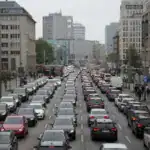
Hamburg, January 20 – Buses in Hamburg are often moving at a snail’s pace, barely exceeding walking speed on some routes. This is primarily due to persistent traffic jams across the city, as revealed in the Senate’s response to an inquiry from the Christian Democratic Union (CDU).
Key Findings on Bus Speeds
The highly utilized Line 6, connecting Speicherstadt and Borgweg, has been identified as Hamburg’s second slowest route, with buses averaging just 14 kilometers per hour. The only line found to be slower is the Arena Shuttle Stellingen/Volksparkstadion, which records an average speed of 7 kilometers per hour. The primary cause for these low speeds, as with other routes in the city, is traffic congestion, particularly around the arenas.
Even Line 5, a flagship route for bus acceleration initiatives and a heavily used service passing through Dammtor and Hoheluftchaussee, including dedicated bus lanes, only manages an average speed of 18 kilometers per hour. The “Hamburger Abendblatt” was the first to report on these findings.
CDU Criticizes Stagnation in Public Transport
CDU Member of Parliament Richard Seelmaecker commented that HVV buses are constantly stuck in traffic, especially during the day. He highlighted the significant impact of these delays on daily commuters and the overall efficiency of public transport in the city.
Conversely, one of the fastest lines is the X30, operating between Bergedorf and Harburg, which achieves an average speed of 37 kilometers per hour. However, the city is unable to provide a direct comparison of current bus speeds with previous years (2024 and 2025) due to changes in measurement methods, which are now more precise.
Future Solutions: Intelligent Traffic Lights
To address the issue, Hamburg plans to implement intelligent traffic light systems designed to automatically adjust green phases for buses. This initiative will involve equipping over 2,000 vehicles and 600 traffic lights across the city with sensors. The project is expected to be completed by 2030, aiming to significantly improve bus flow and reduce travel times.
Impact on Commuters and City Life
The persistent delays have a considerable impact on daily commuters, leading to longer travel times and potential disruptions to schedules. The issue underscores the broader challenge of urban mobility in Hamburg, a city grappling with increasing traffic volumes and the need for efficient public transport solutions.
The city’s efforts to modernize its traffic light infrastructure represent a long-term strategy to alleviate congestion and enhance the reliability of its bus network. However, in the interim, commuters will likely continue to face the frustrations of slow-moving buses.
This topic was broadcast on NDR 90.3 as part of “NDR 90.3 Aktuell” on January 20, 2026, at 13:00.