Munich U-Bahn Lines 3 and 6 to Resume Full Service for Oktoberfest
Munich, August 12 – Renovation work on Munich’s U-Bahn lines 3 and 6, which has caused significant restrictions for passengers, will be suspended in time for Oktoberfest. The closure of the busy route between Sendlinger Tor and Implerstraße, ongoing since May, will be temporarily lifted as planned, according to Munich’s public utility company, Stadtwerke München.
“The U-Bahn can operate without restrictions from Saturday, September 19, and thus during Oktoberfest,” stated a representative. However, inconveniences for passengers will continue after the festival.
Temporary Relief Followed by Further Disruptions
The U-Bahn lines will run as usual only until October 4. Following this, the section will be operational on a single track for nearly two months. After a winter break with regular service between late November and mid-April 2027, the Sendlinger Tor-Implerstraße section will be completely closed again until August. Passengers will need to use replacement buses during this period.
The extensive renovation of the aging Poccistraße and Goetheplatz U-Bahn stations is the reason for these measures. Poccistraße faces structural stability issues, while Goetheplatz requires the repair of construction damage. “Therefore, there is no way around this closure,” emphasized Stadtwerke München.
Passenger Associations Support Renovations but Criticize Replacement Services
Passenger associations concur with the necessity of the renovations. “Infrastructure must be maintained. The example of Deutsche Bahn shows what happens if you neglect it for a few years,” said Berthold Maier from the ‘Arbeitskreis Attraktiver Nahverkehr im Münchner Forum’. Andreas Frank from Pro Bahn also stressed: “It is undisputed that the construction measures are necessary.”
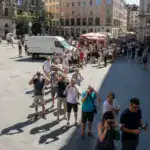
However, the associations are critical of the replacement services. To ensure passengers can reach their destinations despite the closures, the Munich Transport Company (MVG) has set up two replacement bus lines – one following the original U-Bahn route and another as a cross-connection to the main station. Nevertheless, there is widespread dissatisfaction regarding crowding at bus stops, lack of information displays, and significantly longer travel times compared to the U-Bahn.
Frank, however, defends the authorities on the latter point: “People always complain about the MVG not being able to provide a decent replacement service. But the frequency is right, the capacities are right – it’s just that the buses don’t get through smoothly.” During rush hour, buses often get stuck in traffic. Consequently, a relatively new bike path on a main road was recently converted into a bus lane, much to the annoyance of cyclists, whose numbers are meant to be promoted for climate protection reasons, and who now have to share narrow sidewalks with pedestrians. According to Stadtwerke, this measure saves buses about two minutes of travel time.
Calls for Restrictions on Car Traffic
Representatives of both passenger associations advocate for similar solutions: before U3 and U6 trains are halted again, the city should consider restricting individual car traffic. “At first glance, this might seem a bit disproportionate, but on the other hand, the U-Bahn has transported tens of thousands of passengers daily for decades, making a significant contribution to relieving road congestion,” explained Maier. “If renovations are now due, one must consider the passengers so that they can reach their destination as smoothly as possible with replacement buses.”
The current disruptions highlight the challenges of maintaining and upgrading essential urban infrastructure while minimizing inconvenience for daily commuters and special event attendees.
Source: zeit.de