Munich, a city grappling with complex urban development and mobility challenges, finds itself at a crossroads as Clemens Baumgärtner, the CSU’s mayoral candidate, vocally challenges the prevailing traffic policies. His recent press conference, strategically held at an optician’s shop on Fürstenrieder Straße, served as a potent symbol of his critique, directly addressing the visible impact of the city’s infrastructure projects.
A City Under Construction: The Symbolism of Fürstenrieder Straße
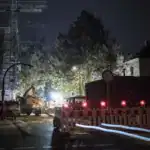
The choice of Fürstenrieder Straße as the backdrop for Baumgärtner’s address was deliberate and impactful. This bustling thoroughfare, currently a sprawling construction zone for the Tram-Westtangente, embodies the candidate’s core concerns. With traffic snaking between barriers and torn-up roadways, and cyclists navigating precariously close to pedestrians, the scene painted a vivid picture of urban disruption.
Baumgärtner asserted that this location starkly illustrates “what green and red politics have as consequences.” He dismissed the notion of a flourishing district, often championed by the Green party, suggesting that the reality on the ground contradicts such idealized visions. His critique is not merely about the inconvenience but about the fundamental approach to urban planning and its real-world effects on citizens and local businesses.
Pragmatism vs. Ideology: Baumgärtner’s Vision for Munich’s Traffic
At the heart of Baumgärtner’s platform is a call for “pragmatic politics.” He argues that necessary construction projects, such as the tram line, must be executed with efficiency and minimal disruption. He advocates for measures like night construction to expedite completion and insists on transparent communication with residents regarding upcoming works. While acknowledging the city’s proposal for a digital construction map, he stresses its utility only if coupled with improved coordination of projects.
The sentiment is echoed by local business owners, such as Christian Particus of Optiker Brillen Müller, who laments the decline of traditional shops and the rise of less desirable establishments like betting offices. Particus, like Baumgärtner, questions the necessity of the tram line, suggesting that the existing bus network was sufficient.
“Incentives, Not Bans”: A New Approach to Mobility
Baumgärtner’s central tenet for traffic policy is “incentives instead of bans.” He contends that the current administration’s approach is inherently “car-hostile,” aiming to banish private vehicles from the city through parking restrictions and the removal of driving lanes. He proposes making public transport more attractive through increased frequency and improved signal technology for subways, rather than coercing residents out of their cars.
Furthermore, he envisions a future where digitalization and artificial intelligence play a pivotal role in traffic management. Digital construction management, AI-powered traffic and signal control, and the deployment of 5G mobile masts on municipal buildings are among his proposals. These initiatives, he argues, would not only enhance mobility but also generate additional revenue for the city.
Beyond Traffic: Housing and Urban Development
Baumgärtner’s vision extends beyond traffic to address Munich’s pressing housing crisis. He advocates for closing building gaps and adding floors to existing structures where feasible, calling for a more flexible interpretation of current building height restrictions. He emphasizes a case-by-case approach, pointing to specific urban spaces that could accommodate additional stories. Speeding up building permit procedures is another key element of his plan to alleviate housing shortages.
The Broader Implications: A Test of Political Will
Baumgärtner’s critique of Munich’s traffic policy is more than just an election campaign. It represents a broader debate about the direction of urban development in German cities. His arguments highlight the tension between ambitious environmental goals and the practical needs of residents and businesses. The question he poses is whether current policies are genuinely effective or merely symbolic gestures that alienate a significant portion of the electorate.
The upcoming mayoral election will be a crucial test of whether Munich’s citizens are ready for a shift towards a more pragmatic, technology-driven approach to urban planning, or if the current trajectory will continue. The outcome will undoubtedly have implications for other German cities facing similar challenges.