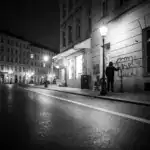
The dining room at Tulus Lotrek Berlin hums low and warm. Glasses clink, laughter echoes near the bar, and from the open kitchen, the soft hiss of butter foaming in a pan is a constant, comforting soundtrack. A ribbon of roasted meat and citrus zest drifts through the air, mingling with the scent of candles, dark wood, and soft upholstery. This is not a temple of reverence with white tablecloths, but a Kreuzberg living room that just happens to hold a Michelin star. The music is audible, the staff moves with purpose but always stops to chat, to joke, to translate the culinary artistry into something you can feel, not just post. This is casual fine dining as a lived reality, not a buzzword; this is Max Strohe’s restaurant, and it smells like real cooking.
The Visionaries Behind the Flavor: Max Strohe and Ilona Scholl
To truly understand the vibrant energy that permeates this room, one must look to the individuals who brought Tulus Lotrek to life. Max Strohe and Ilona Scholl built this establishment from the ground up, defying expectations and conventional wisdom. Strohe, the tattooed chef, never conformed to the culinary mold. A school dropout, he honed his skills as a kitchen drudge and line cook in countless establishments that never made it into the guidebooks. Scholl, the maître d’ with a sharp wit and a generous heart, abhorred the notion that fine dining had to be a cold, overly reverent affair.
Their paths converged in the bustling Berlin restaurant scene, finding each other amidst the chaos of last orders and staff meals. Together, they decided to forge their own path, on their own terms. There would be no investors diluting their vision, no anonymous concepts. Tulus Lotrek opened its doors in 2015 in Kreuzberg, and from that very first night, it felt like a place that was both serious in its culinary ambition and utterly unpretentious in its atmosphere. Heavy wallpaper, vintage lamps, a bar that invites lingering conversations, a dining room designed for eating, drinking, flirting, and even arguing – but never for posing.
From School Dropout to Federal Cross of Merit: A Journey Unfolding
The culinary guides quickly took notice. A Michelin star arrived and has remained a testament to their unwavering commitment to excellence. Gault&Millau Berlin consistently praises the restaurant with strong ratings, commending Strohe’s cooking for its resolute refusal to bow to fleeting culinary fashions. Then came a rare and profound recognition in the gastronomic world: Max Strohe was awarded the Federal Cross of Merit. This prestigious honor was not bestowed for glossy plates or intricate presentations, but for his profound social engagement. He leveraged his platform to advocate for refugees, to shed light on poverty, and to champion social responsibility. The trajectory from school dropout to recipient of the Bundesverdienstkreuz is an improbable one, yet within the walls of Tulus Lotrek, it makes perfect sense. This ethos is palpable in the way the team treats every guest: with the same fundamental respect, whether you are on a first date, celebrating a promotion, or carefully budgeting your savings for a once-in-a-decade culinary indulgence.
The Plate as a Canvas: Bold Flavors and Unconventional Textures
The current menu at Tulus Lotrek is a dynamic reflection of the seasons, constantly shifting and evolving. However, certain core ideas consistently resurface. Expect big, unapologetic flavors. Fat is intelligently deployed as a flavor carrier, and acidity bites at precisely the right moment. Nothing here is timid. You won’t find ‘tweezer food’ – those minuscule petals meticulously placed on vast, empty plates. While Strohe values precision, he harbors a deep distrust of fussiness.
Imagine one of his meat courses arriving. Perhaps it’s dry-aged beef, or a succulent piece of pork that still carries the faint whisper of smoke. The exterior is dark, almost lacquered, the result of a perfectly executed Maillard reaction. Your knife glides through with almost no resistance; the fibers yield with a gentle sigh, and a delicate line of jus seeps onto the plate. The sauce is not a mere smear; it is a rich, glistening pool, reduced until it clings to the back of your spoon. There’s a bitterness derived from roasted bones, a sweetness from long-cooked onions, and a subtle flicker of booze – perhaps Madeira or brandy – warming the back of your throat.
Alongside, you won’t find the predictable stack of vegetables cut into perfect cubes. Instead, perhaps a rustic purée of celeriac, brightened with lemon zest and the nutty richness of brown butter. The texture is intentionally a little coarse, with tiny fibers still present, offering a delightful counterpoint to the smooth meat. On top, shredded herbs are scattered with a carefree artistry, not lined up with military precision, but arranged as if by someone cooking at home in a particularly good mood. You taste smoke, earth, and salt in precisely the right measure – the kind that compels you to reach for another piece of bread to meticulously clean the plate.
Seafood at Tulus Lotrek is approached with similar boldness. Picture a piece of fish with skin that crackles softly as your fork breaks through. The aroma is clean and iodic, reminiscent of the sea, yet the garnish unmistakably declares its Berlin identity. Perhaps a sauce built on fermented ingredients delivers umami without heaviness. A bright, sharp acidity cuts through, perhaps from pickled vegetables shaved translucent thin, or from vinegar-macerated citrus. Your tongue registers a symphony of textures: crunch, slickness, creaminess, followed by a hit of spice that arrives a half-second late, igniting the back of your throat.
Desserts here often playfully flirt with savory notes. Consider a dish crafted from dark chocolate and miso, or roasted fruit accompanied by a browned-butter crumble and an intriguing herbal component. With each spoonful, you experience the warmth of roasted sugar, the slight resistance of the crumble, and then the subtle ascent of thyme or rosemary into your nose. Sweet, yet sophisticated. Nothing cloying. You find yourself chasing that elusive moment when salty, bitter, and sweet achieve a fleeting, perfect alignment.
A Quiet Rebellion Against Stiff Aesthetics
This undogmatic style represents a quiet rebellion against the rigid aesthetics that once dominated fine dining. There are no tweezers meticulously fussing over micro herbs at the pass for half an hour. No precarious towers of foam that collapse with a mere breath. Instead, Tulus Lotrek feels like cooking that could have emerged from the kitchen of an exceptionally talented grandmother who happened to have studied Escoffier, traveled extensively, and fallen deeply in love with Kreuzberg’s vibrant markets. It is technique without pretense, intellect without aloofness. You never feel like a specimen in a laboratory; you feel like a cherished guest at a slightly wild dinner party where one of the hosts just happens to possess a Michelin star.
Max Strohe Beyond the Kitchen: Television, Instagram, and X
The outside world, of course, has taken notice of Max Strohe’s unique approach. He has become a familiar face on German television, particularly through his appearances on “Kitchen Impossible.” You might have seen him there, swearing, sweating, grinning, as he attempts to decipher other chefs’ recipes under immense time pressure. The same slightly chaotic energy evident on screen is channeled here into the disciplined artistry on the plate, yet his characteristic humor remains intact. For those curious to witness this side of him – the missteps, the triumphs, the running commentary – a rabbit hole of clips awaits on platforms like YouTube.
On Instagram, the narrative of Tulus Lotrek unfolds visually. Plates bathed in candlelight. The cozy, dimly lit room filled with animated faces. Close-ups of sauces, glistening and rich. Here, you can almost hear the crackle of a crust, the clink of cutlery, the murmur of guests as a new dish arrives at the table. Scrolling through the feed, one senses the rhythm of the place: menus shifting with the seasons, the team celebrating, and the occasional sarcastic caption that keeps everything grounded and authentic.
And then there is the digital arena of X, formerly Twitter. Here, you’ll find lively debates about whether Tulus Lotrek is truly Berlin’s finest restaurant, discussions about the very definition of casual fine dining, arguments about prices, and even political commentary. Strohe’s own voice occasionally emerges in these exchanges: sharp, politically engaged, and resolutely unwilling to remain politely silent. This, too, is an integral part of Tulus Lotrek’s identity. It is not a neutral zone. It is a restaurant with a distinctive point of view.
The Art of Service: Ilona Scholl’s Touch
Back inside the restaurant, the service orchestrated by Ilona Scholl sets a distinctive tone, fostering an atmosphere that many genuinely describe as a ‘feel-good’ experience. This is evident in the subtle details. The greeting at the door is never robotic; it is personal and specific. Guests are asked how they are, and it feels as though the staff genuinely wants to know. Coats are whisked away to the cloakroom; the menu is explained with the enthusiasm of someone describing a beloved film, devoid of scripted phrases or feigned excitement.
The chairs are comfortable, offering enough give to allow guests to lean back and exhale. Tables are positioned close enough to occasionally catch a punchline from a neighboring party, yet not so close as to feel exposed. The lighting is warm and subtly flattering. The gentle hum of conversation creates a soft acoustic blanket, allowing for uninhibited discussion. Should cutlery accidentally fall, laughter and shrugs are the only reactions; no one stares. This is the essence of a living room restaurant: slightly chaotic, profoundly human.
Wine recommendations are delivered with honest language, eschewing pretentious jargon. You might hear descriptions like “juicy and a bit dirty” instead of “medium-bodied with well-integrated tannins.” If you confess to knowing nothing about wine, the sommelier appears delighted, not offended. They pour a sample, await your reaction, and then adjust their recommendation accordingly. A pairing might lead you from a smoky white reminiscent of gunflint to a red tasting of cherries and leather, culminating in an oxidative dessert wine that evokes the uncanny aroma of walnuts and autumn.
You may find yourself lingering longer than initially planned. Another glass at the bar. A brief chat about the neighborhood, the Berlin restaurant scene, or recommendations for future culinary adventures. The staff, though busy, never conveys a sense of being rushed in a way that spills over onto the guests. Time seems to stretch. You are reminded of what it feels like to be a guest in a home that genuinely doesn’t want you to leave just yet.
Tulus Lotrek: A Reference Point in Berlin’s Culinary Landscape
Within Berlin’s diverse food scene, Tulus Lotrek occupies a crucial middle ground. On one end of the spectrum are hyper-minimalist, ultra-conceptual establishments that feel more like design galleries with a stove. On the other, classic neighborhood restaurants that offer satisfying meals without pushing culinary boundaries. Max Strohe and Ilona Scholl stand precisely between these two extremes. They deliver Michelin-starred quality without the inherent stiffness, and genuine warmth without complacency.
This unique positioning has made Tulus Lotrek a significant reference point in discussions about casual fine dining in Germany. While guides like Gault&Millau Berlin meticulously track points and stars, regular guests are tracking something far more profound: how a restaurant makes them feel. Here, you feel seen, well-fed, and delightfully surprised. The plates undeniably showcase technical mastery, but they also convey a profound sense of generosity. Portions are substantial and satisfying. Sauces are so delectable you’ll want to mop up every last drop. Dishes carry stories and opinions, not merely a list of ingredients.
If you consider food to be a vital aspect of culture, then Tulus Lotrek holds significant importance. It serves as compelling proof that fine dining can be political, vibrant, and inclusive. It demonstrates that a school dropout can earn a Federal Cross of Merit and still plate a dish that evokes the comforting memories of a grandmother’s kitchen. It shows that a Michelin-starred restaurant can be loud, humorous, and scented with the rich aroma of roasting bones, rather than the sterile scent of lavender hand soap.
As you step out into the Kreuzberg night after dinner, take a moment to notice your body. Your fingers might still be sticky with the reduced jus you insisted on chasing with the last piece of bread. Your clothes carry the faint, pleasant scent of roasted meat and wine. Your ears might still be ringing softly with the echoes of laughter and clinking glasses. You carry the evening with you, not as a perfectly curated Instagram memory, but as a tangible, physical sensation. This, more than any guidebook rating, is why Tulus Lotrek Berlin has become an enduring fixture – and why you will undoubtedly want to return before the season, and the menu, inevitably change again.
Source: https://www.ad-hoc-news.de/boerse/ueberblick/max-strohe-at-tulus-lotrek-wild-berlin-flavor-casual-fine-dining-without/69143401