New District for 4,000 Residents: Munich’s Lerchenauer Feld Rapidly Expanding
Munich, July 29 – One of the largest new residential areas in the city is taking shape on the Lerchenauer Feld in the Feldmoching-Hasenbergl district. The Bayerische Hausbau has laid the cornerstone for the first 165 apartments, part of a larger project that will eventually house 4,000 people in subsidized and owner-occupied housing.
Rapid Development in Feldmoching
The future large municipal school, which children will attend once the residential buildings are completed, has already taken significant form. The future sports campus on the 23-hectare Lerchenauer Feld is also well advanced. Between these municipal buildings in Feldmoching, Bayerische Hausbau Development has now begun the shell construction of 165 owner-occupied apartments.
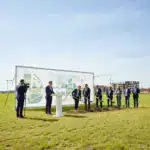
Balloons adorned the construction fence on Tuesday (July 28) as the cornerstone was laid for “Parkside Lerchenauer Feld.” In total, Hausbau plans to build 600 apartments at Lerchenauer Straße, corner Georg-Zech-Allee. Following the project on the former Paulaner site, “Parkside” is the next major residential construction project by the Schörghuber Group.
A New Urban Quarter with 1,650 Apartments
By approximately 2032, a completely new residential district with around 1,650 apartments is expected to be completed on the Lerchenauer Feld. The Gräfelfing-based company Concept Bau is constructing 700 apartments here. Additionally, the municipal Münchner Wohnen plans to build around 500 affordable apartments.
“In total, 4,000 new residents will hopefully find their home here,” said City Building Councillor Elisabeth Merk (non-party). She emphasized that this will be a clear “residential location for families.”
In front, Bayerische Hausbau is building, and behind it, the new large school building (gymnasium and elementary school) is already taking shape. Cooperatives will also build here, with about half of all new apartments designated as subsidized housing and 23 percent as owner-occupied apartments. “We also need mixed urban districts,” Merk said. “Where people meet, even in everyday life, and it doesn’t matter at the bakery how much household income one has.” The City Building Councillor thanked the Schörghuber Group for remaining true to its tradition of building in its third generation.
Schörghuber Group’s Commitment to Munich
Florian Schörghuber, grandson of company founder Josef Schörghuber and CEO of the family business since 2022, stated that Bayerische Hausbau remains the “nucleus” of the company. “In 1994, my grandfather began to create living spaces and working environments in this wonderful city.” Since then, they have developed places that shape Munich, such as the Arabellahaus, which is now being further developed. “We are building. And that is not a given today,” said Schörghuber.
Much is happening in terms of residential construction in northern Munich. The Feldmoching-Hasenbergl district, in particular, “has a lot to contribute to urban development,” said Elisabeth Merk: 610 new apartments are being built on Hochmuttinger Straße, 1,900 in the Ludwigsfeld settlement, and another 900 in the Ratold- and Raheinstraße quarter. In the controversial Eggarten, 1,900 residential units are planned. “Ultimately, we are building smaller cities within the big city,” said City Building Councillor Elisabeth Merk.
Public Reaction and Future Outlook
The development has sparked discussion among residents. Comments on the article reflect concerns about the impact on green spaces and food security. One commenter, “eule75,” expressed worries about “concrete over cultivable land” and questioned what politicians would do if Germany could no longer feed itself. Another commenter, “Boandl_kramer,” humorously suggested fleeing into exile. “Der wahre tscharlie” countered, pointing out that houses are always built on “cultivable land,” such as meadows or abandoned fields, and questioned the relevance of food imports from distant countries.
The project underscores Munich’s ongoing efforts to address housing shortages and accommodate its growing population. The emphasis on mixed-use developments and a significant portion of subsidized housing aims to create inclusive communities. The Lerchenauer Feld development is a key part of the city’s strategy to expand its urban footprint while attempting to balance growth with community needs.